PHYSICS / ENGINEERING / COMPUTING
Nuclear physics: fission and fusion
Explain binding energy, radioactive decay, fission and fusion energy accounting, and plasma energy balance with twenty worked examples.
Matter pathway: atom → solid → liquid → gas → plasma. Quantum mechanics and quantum field theory provide foundations across the pathway; they are not additional phases. This is a connected modeling route, not a universal heating curve. Actual phases depend on pressure, composition, and kinetics.
1. Binding energy and reaction Q values
Definitions & inputs. m denotes rest mass, c light speed; one atomic mass unit u has uc²≈931.494 MeV.
Mass missing from separated nucleons is binding energy.
Rest-mass decrease becomes kinetic energy and radiation when Q is positive.
Convert nuclear energy per event into SI units before calculating power.
Interpretation. Binding per nucleon explains why both splitting heavy nuclei and combining light nuclei can release energy.
↑ Return to definitions and contents2. Radioactive decay and activity
Definitions & inputs. N atom count, λ decay constant, τ mean lifetime, t1/2 half-life, A activity in becquerels.
Integrate the exponential rate equation.
Half-life and mean lifetime differ by ln2.
Activity counts decays per second, not emitted energy or biological dose.
Interpretation. Decay chains and exposure assessments need additional models and isotope data.
↑ Return to definitions and contents3. Fission energy and conversion budgets
Definitions & inputs. Qf prescribed recoverable energy per fission, Rf fission rate, ηth electric conversion efficiency.
Multiply heat per reaction by reaction rate.
A heat engine rejects part of its thermal input.
A prescribed multiplication factor summarizes an idealized neutron-generation balance; reactor prediction needs transport and kinetics.
Interpretation. Delayed neutrons, feedback, heat removal, and material behavior are central to actual reactor dynamics.
↑ Return to definitions and contents4. Fusion reaction rate and plasma energy balance
Definitions & inputs. D,T deuterium/tritium ions, nD,nT densities, ⟨σv⟩ reactivity, W stored plasma energy, τE energy confinement time.
A common fusion reaction releases energy mainly to the neutron and alpha particle.
For distinct reactants multiply both densities, reactivity, volume, and energy per event.
Stored energy loss and plasma gain differ from facility electrical efficiency.
Interpretation. Scientific plasma gain is not wall-plug or net-electric gain. Continue through sections 5–8 below to derive the cross section, its energy dependence, and the thermal reactivity used in this rate equation.
↑ Return to definitions and contents5. Fusion cross section: effective area, energy and channel
Definitions & inputs. σab(E) is the fusion cross section for a specified reaction channel, in m²; 1 barn (b)=10⁻²⁸ m². J is incident particle flux (m⁻² s⁻¹), nt target number density, ℓ path length, and Γ the reaction frequency for one target particle. E is centre-of-mass relative kinetic energy, μ=mamb/(ma+mb) the reduced mass, and vrel the relative speed.
Operational definition: divide the number of reactions per target particle per second by the incident flux. Fusion and elastic scattering have different channel cross sections.
Multiply effective area by the number of targets per unit transverse area. Only this dimensionless product approximates a per-projectile fusion probability in a thin target.
For a stationary target b, convert projectile laboratory energy into centre-of-mass energy before using a table or fit. A deuteron on a stationary triton has Ecm≈3Elab/5 using mass numbers.
Worked unit check: use a hypothetical supplied cross section, convert barns to square metres, and multiply by the target column density. This does not assign a measured cross section to any real reaction or energy.
Interpretation. Always identify the reacting species, product branch, energy frame, energy units, and whether the value is measured, evaluated, or fitted. Total D–D fusion combines the neutron and proton branches; a branch-specific cross section counts only that product channel. Experimental uncertainties and fit ranges matter.
↑ Return to definitions and contents6. Why the cross section depends strongly on energy
Definitions & inputs. Za,Zb are nuclear charge numbers, α the fine-structure constant, c light speed, μ reduced mass, S(E) the astrophysical S factor (energy times area), EG a Coulomb energy scale, and θ=kBT the thermal energy. S(E) here is not the liquid structure factor S(k).
Separate the approximate Coulomb tunneling suppression from the remaining nuclear physics. At low collision energy, repulsion makes reaching short-range nuclear interactions unlikely even when the reaction releases energy.
The thermal reaction integral balances a decreasing high-energy population against increasing barrier penetration. It is not dominated simply by the mean ion energy.
For slowly varying S(E), differentiate the exponent to locate the most strongly weighted collision energy.
Solve the stationary-point condition. The contributing range around E0 is called the Gamow window; a resonant S(E) changes the weighting.
Interpretation. Temperature does not set one collision energy. Fusion can occur by tunneling below a classical Coulomb-barrier estimate, but tunneling alone does not determine the reaction probability. D–T has important nuclear resonance structure, so a constant-S estimate must not replace a validated D–T parametrization.
↑ Return to definitions and contents7. Derive thermal reactivity from the cross section
Definitions & inputs. fa(v),fb(v) are velocity probability densities normalized to one; σ(E) is in m², vrel in m/s, θ=kBT in joules, μ in kg, and ⟨σv⟩ in m³/s. na,nb are number densities; δab=1 for identical reactants and zero for distinct species.
Average the product of reaction area and relative speed over all reacting pairs. Multiplying a cross section at a chosen mean energy by a mean speed generally gives a different answer.
The difference of independent Maxwellian velocities has a Maxwellian distribution with reduced mass μ and the common thermal energy θ.
Integrate over directions, contributing 4πv²dv, and retain the extra v from collision rate.
Change integration variable from relative speed to collision energy and collect the prefactor. Use joules consistently in both the exponent and dimensional prefactor, or convert an explicitly unit-specific fit.
Count distinct pairs once. D–T needs no factor of one half; identical D–D pairs do. Multiply reactions per cubic metre per second by joules per reaction to obtain fusion power density.
Interpretation. The existing prescribed-rate example uses ⟨σv⟩=10⁻²² m³/s; it is a rate coefficient, not a cross section of 10⁻²² m². For a measured prediction, select the channel and valid energy interval, integrate σ(E) with the distribution, or use a validated thermal-reactivity fit such as Bosch–Hale within its stated range.
↑ Return to definitions and contents8. Worked analytical check: a constant-cross-section toy model
Definitions & inputs. Prescribe σ0=1 barn=10⁻²⁸ m² independent of energy, μ=2.0×10⁻²⁷ kg, θ=10 keV=1.602176634×10⁻¹⁵ J, and two distinct species with na=nb=5×10¹⁹ m⁻³. This toy σ0 is not a measured D–T cross section.
Substitute u=E/θ; integration by parts gives the dimensionless integral equal to one.
Insert the exact integral into the Maxwellian formula. Only because σ is constant can it be taken outside the average.
Compute the mean relative speed using the reduced mass and thermal energy in SI units.
Multiply by σ0 and then the distinct-species density product. This completes the chain from area to rate coefficient to reactions per volume per time.
Interpretation. This benchmark isolates unit conversion, the Maxwellian prefactor and pair counting. In real fusion, substitute the energy-dependent channel cross section; do not treat this constant-area benchmark as an evaluated nuclear datum.
↑ Return to definitions and contentsGraphical worked example
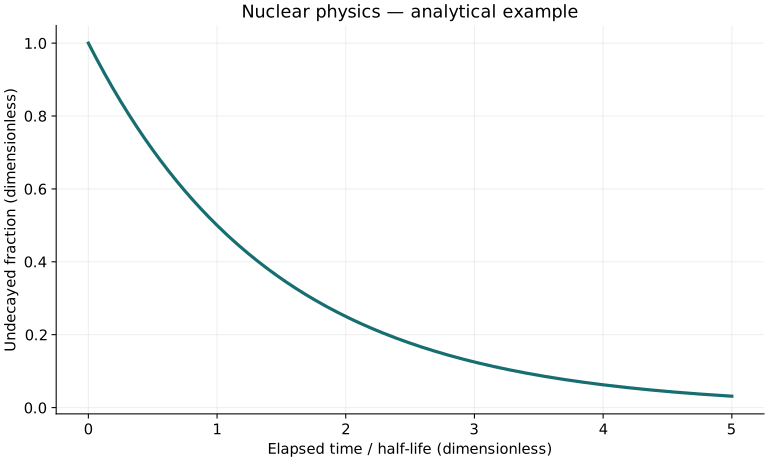
Twenty worked examples
Open a problem to see its defined inputs, assumptions, equation, numerical substitution, result, and interpretation. Values are illustrative analytical exercises.
Example 01. Mass defect to energy
Definitions & inputs. Consistently defined reaction mass defect Δm=0.002 u.
Choose the governing model and isolate the requested quantity.
Insert the stated inputs in consistent units or the explicitly defined normalized units.
Evaluate the expression; the result uses the units shown.
Interpretation. This is the energy for the stated mass difference, not a named measured reaction.
↑ Return to definitions and contentsExample 02. Binding energy per nucleon
Definitions & inputs. Total binding B=28.3 MeV, A=4 nucleons.
Choose the governing model and isolate the requested quantity.
Insert the stated inputs in consistent units or the explicitly defined normalized units.
Evaluate the expression; the result uses the units shown.
Interpretation. Binding per nucleon supports comparisons between nuclei.
↑ Return to definitions and contentsExample 03. Fission event energy in joules
Definitions & inputs. Prescribe recoverable Qf=200 MeV.
Choose the governing model and isolate the requested quantity.
Insert the stated inputs in consistent units or the explicitly defined normalized units.
Evaluate the expression; the result uses the units shown.
Interpretation. Recoverable energy must be defined consistently with the thermal-power budget.
↑ Return to definitions and contentsExample 04. Fission rate for one megawatt
Definitions & inputs. Thermal power 10⁶ W, Qf=200 MeV per event.
Choose the governing model and isolate the requested quantity.
Insert the stated inputs in consistent units or the explicitly defined normalized units.
Evaluate the expression; the result uses the units shown.
Interpretation. This is a reaction-rate energy balance, not a core design.
↑ Return to definitions and contentsExample 05. Heat engine electric output
Definitions & inputs. Thermal power 100 MW, electric efficiency 0.33.
Choose the governing model and isolate the requested quantity.
Insert the stated inputs in consistent units or the explicitly defined normalized units.
Evaluate the expression; the result uses the units shown.
Interpretation. Electrical output excludes auxiliary plant consumption in this simple figure.
↑ Return to definitions and contentsExample 06. Rejected heat
Definitions & inputs. Thermal input 100 MW and electrical output 33 MW.
Choose the governing model and isolate the requested quantity.
Insert the stated inputs in consistent units or the explicitly defined normalized units.
Evaluate the expression; the result uses the units shown.
Interpretation. Heat rejection remains substantial even with high nuclear energy density.
↑ Return to definitions and contentsExample 07. Energy over one day
Definitions & inputs. Constant thermal power 1 MW for 86400 s.
Choose the governing model and isolate the requested quantity.
Insert the stated inputs in consistent units or the explicitly defined normalized units.
Evaluate the expression; the result uses the units shown.
Interpretation. This is thermal energy, not electricity unless the power was electrical.
↑ Return to definitions and contentsExample 08. Decay constant
Definitions & inputs. Half-life 10 hours.
Choose the governing model and isolate the requested quantity.
Insert the stated inputs in consistent units or the explicitly defined normalized units.
Evaluate the expression; the result uses the units shown.
Interpretation. Convert hours to seconds before computing becquerels.
↑ Return to definitions and contentsExample 09. Remaining fraction after three half-lives
Definitions & inputs. t=3t1/2.
Choose the governing model and isolate the requested quantity.
Insert the stated inputs in consistent units or the explicitly defined normalized units.
Evaluate the expression; the result uses the units shown.
Interpretation. One eighth of the initial parent population remains.
↑ Return to definitions and contentsExample 10. Mean lifetime
Definitions & inputs. Half-life 10 hours.
Choose the governing model and isolate the requested quantity.
Insert the stated inputs in consistent units or the explicitly defined normalized units.
Evaluate the expression; the result uses the units shown.
Interpretation. Mean lifetime is longer than half-life.
↑ Return to definitions and contentsExample 11. Activity from atom count
Definitions & inputs. N=10¹² atoms, half-life 3600 s.
Choose the governing model and isolate the requested quantity.
Insert the stated inputs in consistent units or the explicitly defined normalized units.
Evaluate the expression; the result uses the units shown.
Interpretation. Activity alone does not determine absorbed or effective dose.
↑ Return to definitions and contentsExample 12. Decay age from a quarter remaining
Definitions & inputs. Half-life 5730 years, N/N0=0.25.
Choose the governing model and isolate the requested quantity.
Insert the stated inputs in consistent units or the explicitly defined normalized units.
Evaluate the expression; the result uses the units shown.
Interpretation. Real radiocarbon ages require calibration and contamination controls.
↑ Return to definitions and contentsExample 13. D–T energy in joules
Definitions & inputs. Q=17.6 MeV.
Choose the governing model and isolate the requested quantity.
Insert the stated inputs in consistent units or the explicitly defined normalized units.
Evaluate the expression; the result uses the units shown.
Interpretation. Both neutron and alpha energies belong to the total fusion energy.
↑ Return to definitions and contentsExample 14. Two-body neutron energy share
Definitions & inputs. Available kinetic Q=17.6 MeV, alpha-to-neutron mass ratio approximated as four.
Choose the governing model and isolate the requested quantity.
Insert the stated inputs in consistent units or the explicitly defined normalized units.
Evaluate the expression; the result uses the units shown.
Interpretation. Opposite equal momenta give inverse-mass kinetic-energy sharing in this nonrelativistic approximation.
↑ Return to definitions and contentsExample 15. Alpha energy share
Definitions & inputs. Same approximate D–T kinematics.
Choose the governing model and isolate the requested quantity.
Insert the stated inputs in consistent units or the explicitly defined normalized units.
Evaluate the expression; the result uses the units shown.
Interpretation. Alpha particles can heat a confined plasma; neutrons primarily carry energy out.
↑ Return to definitions and contentsExample 16. Fusion rate for one megawatt
Definitions & inputs. Total fusion power 10⁶ W, 17.6 MeV per event.
Choose the governing model and isolate the requested quantity.
Insert the stated inputs in consistent units or the explicitly defined normalized units.
Evaluate the expression; the result uses the units shown.
Interpretation. This does not specify the conditions needed to realize the rate.
↑ Return to definitions and contentsExample 17. Temperature energy scale
Definitions & inputs. kBT=10 keV; kB=8.617333262×10⁻⁵ eV/K.
Choose the governing model and isolate the requested quantity.
Insert the stated inputs in consistent units or the explicitly defined normalized units.
Evaluate the expression; the result uses the units shown.
Interpretation. Temperature alone does not guarantee an adequate fusion rate or confinement.
↑ Return to definitions and contentsExample 18. Prescribed fusion rate density
Definitions & inputs. nD=nT=5×10¹⁹ m⁻³, reactivity=10⁻²² m³/s.
Choose the governing model and isolate the requested quantity.
Insert the stated inputs in consistent units or the explicitly defined normalized units.
Evaluate the expression; the result uses the units shown.
Interpretation. Reactivity is an assumed input; it must come from the relevant energy distribution and cross section.
↑ Return to definitions and contentsExample 19. Energy confinement time
Definitions & inputs. Stored thermal energy W=10 MJ, loss power=5 MW.
Choose the governing model and isolate the requested quantity.
Insert the stated inputs in consistent units or the explicitly defined normalized units.
Evaluate the expression; the result uses the units shown.
Interpretation. This is an energy confinement time, not a particle lifetime.
↑ Return to definitions and contentsExample 20. Plasma gain
Definitions & inputs. Fusion power=50 MW, external plasma heating=10 MW.
Choose the governing model and isolate the requested quantity.
Insert the stated inputs in consistent units or the explicitly defined normalized units.
Evaluate the expression; the result uses the units shown.
Interpretation. Qplasma=5 does not establish net electrical output after heating and plant losses.
↑ Return to definitions and contentsSymbols and units
Each derivation and problem defines its own symbols and inputs. Symbols may be reused with different meanings in other subjects. Keep units consistent, retain sufficient precision during calculation, and apply the stated validity limits.