PHYSICS / ENGINEERING / COMPUTING
Submarine and research-submersible design
Study submerged buoyancy, trim, external pressure, resistance and life-support energy budgets using civilian research-submersible examples.
Matter pathway: atom → solid → liquid → gas → plasma. Quantum mechanics and quantum field theory provide foundations across the pathway; they are not additional phases. This is a connected modeling route, not a universal heating curve. Actual phases depend on pressure, composition, and kinetics.
1. Submerged buoyancy and ballast
Definitions & inputs. V displaced external volume,m mass,ρ water density,Δm ballast change.
Net vertical force is buoyancy minus weight.
Neutral buoyancy requires matching total mass to displaced-water mass.
Added ballast decreases upward force if external displacement is unchanged.
Interpretation. Compressibility, salinity and temperature alter buoyancy; emergency ascent requires a validated independent system.
↑ Return to definitions and contents2. Trim and submerged static stability
Definitions & inputs. zB,zG centers of buoyancy and gravity,θ pitch,weights mi at positions xi.
Mass moments determine longitudinal center of gravity.
A buoyancy center above the gravity center gives a restoring couple.
Transferring ballast shifts trim moment.
Interpretation. Do not use surface-ship metacentric formulas unchanged for a fully submerged body.
↑ Return to definitions and contents3. Pressure hull: stress versus collapse
Definitions & inputs. h depth,p external pressure,R radius,t wall thickness,E modulus,ν Poisson ratio.
Integrate hydrostatic equilibrium at constant density.
Spherical membrane compression follows force balance on a hemisphere.
Classical elastic buckling is an ideal-shell benchmark, not an allowable pressure.
Interpretation. Real shells have imperfections, openings, joints, residual stresses and fatigue. Cylinders have different buckling formulas and boundary sensitivity; use validated standards and tests.
↑ Return to definitions and contents4. Drag, power and endurance
Definitions & inputs. CD drag coefficient,A frontal area,V speed,η propulsive efficiency,Eusable stored energy,Pload total power.
Pressure and viscous effects are combined in a characterized drag coefficient.
Mechanical power rises rapidly with speed if coefficients remain fixed.
Include propulsion, control, sensors, thermal management and life-support loads in an endurance budget.
Interpretation. Battery reserve, oxygen, carbon-dioxide removal and thermal conditions can impose different endurance limits.
↑ Return to definitions and contentsGraphical worked example
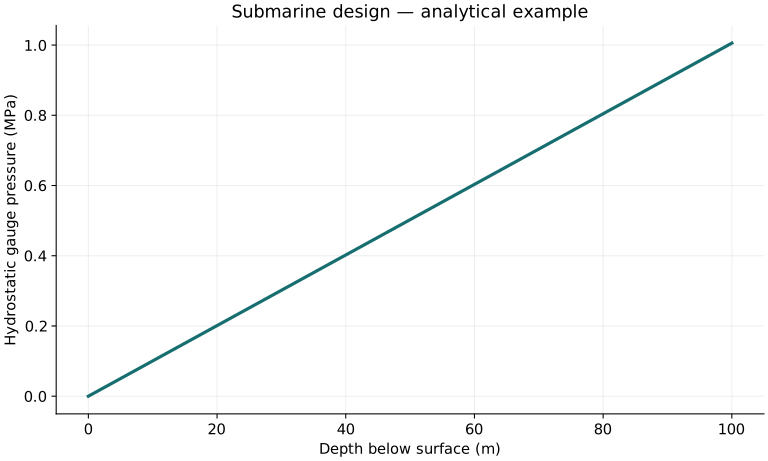
Twenty worked examples
Open a problem to see its defined inputs, assumptions, equation, numerical substitution, result, and interpretation. Values are illustrative analytical exercises.
Example 01. Neutral mass
Definitions & inputs. V10m³,ρ1025kg/m³.
Choose the governing model and isolate the requested quantity.
Insert the stated inputs in consistent units or the explicitly defined normalized units.
Evaluate the expression; the result uses the units shown.
Interpretation. Fully submerged displacement.
↑ Return to definitions and contentsExample 02. Positive buoyancy
Definitions & inputs. SameV,m10000kg,g9.81.
Choose the governing model and isolate the requested quantity.
Insert the stated inputs in consistent units or the explicitly defined normalized units.
Evaluate the expression; the result uses the units shown.
Interpretation. Upward net force.
↑ Return to definitions and contentsExample 03. Ballast for neutrality
Definitions & inputs. Neutral10250kg,current10000kg.
Choose the governing model and isolate the requested quantity.
Insert the stated inputs in consistent units or the explicitly defined normalized units.
Evaluate the expression; the result uses the units shown.
Interpretation. Fixed external volume.
↑ Return to definitions and contentsExample 04. Density sensitivity
Definitions & inputs. V10m³,Δρ5kg/m³.
Choose the governing model and isolate the requested quantity.
Insert the stated inputs in consistent units or the explicitly defined normalized units.
Evaluate the expression; the result uses the units shown.
Interpretation. Neutral mass changes with water density.
↑ Return to definitions and contentsExample 05. Pressure at10m
Definitions & inputs. ρ1025,g9.81,h10m.
Choose the governing model and isolate the requested quantity.
Insert the stated inputs in consistent units or the explicitly defined normalized units.
Evaluate the expression; the result uses the units shown.
Interpretation. Gauge pressure, not absolute.
↑ Return to definitions and contentsExample 06. Pressure at100m
Definitions & inputs. Same water.
Choose the governing model and isolate the requested quantity.
Insert the stated inputs in consistent units or the explicitly defined normalized units.
Evaluate the expression; the result uses the units shown.
Interpretation. Constant density approximation.
↑ Return to definitions and contentsExample 07. Absolute pressure
Definitions & inputs. Gauge1MPa,surface101325Pa.
Choose the governing model and isolate the requested quantity.
Insert the stated inputs in consistent units or the explicitly defined normalized units.
Evaluate the expression; the result uses the units shown.
Interpretation. Distinguish inside–outside differential from absolute pressure.
↑ Return to definitions and contentsExample 08. Sphere membrane stress
Definitions & inputs. Δp1MPa,R1m,t.02m.
Choose the governing model and isolate the requested quantity.
Insert the stated inputs in consistent units or the explicitly defined normalized units.
Evaluate the expression; the result uses the units shown.
Interpretation. Not a buckling allowable.
↑ Return to definitions and contentsExample 09. Thickness scaling
Definitions & inputs. Doublet at fixed p,R.
Choose the governing model and isolate the requested quantity.
Insert the stated inputs in consistent units or the explicitly defined normalized units.
Evaluate the expression; the result uses the units shown.
Interpretation. Membrane stress scaling only.
↑ Return to definitions and contentsExample 10. Ideal buckling scaling
Definitions & inputs. Doublet/R at fixed material.
Choose the governing model and isolate the requested quantity.
Insert the stated inputs in consistent units or the explicitly defined normalized units.
Evaluate the expression; the result uses the units shown.
Interpretation. Real imperfection knockdowns not included.
↑ Return to definitions and contentsExample 11. Longitudinal CG
Definitions & inputs. Mass100kgat0m and300kgat2m.
Choose the governing model and isolate the requested quantity.
Insert the stated inputs in consistent units or the explicitly defined normalized units.
Evaluate the expression; the result uses the units shown.
Interpretation. Common reference datum.
↑ Return to definitions and contentsExample 12. Trim transfer moment
Definitions & inputs. Δm20kg,Δx2m.
Choose the governing model and isolate the requested quantity.
Insert the stated inputs in consistent units or the explicitly defined normalized units.
Evaluate the expression; the result uses the units shown.
Interpretation. Sign depends on transfer direction.
↑ Return to definitions and contentsExample 13. Submerged restoring moment
Definitions & inputs. m10000kg,zB−zG.1m,pitch5°.
Choose the governing model and isolate the requested quantity.
Insert the stated inputs in consistent units or the explicitly defined normalized units.
Evaluate the expression; the result uses the units shown.
Interpretation. Positive separation gives restoring tendency.
↑ Return to definitions and contentsExample 14. Drag
Definitions & inputs. ρ1025,V2m/s,A2m²,CD.2.
Choose the governing model and isolate the requested quantity.
Insert the stated inputs in consistent units or the explicitly defined normalized units.
Evaluate the expression; the result uses the units shown.
Interpretation. Coefficient is illustrative.
↑ Return to definitions and contentsExample 15. Tow power
Definitions & inputs. D820N,V2m/s.
Choose the governing model and isolate the requested quantity.
Insert the stated inputs in consistent units or the explicitly defined normalized units.
Evaluate the expression; the result uses the units shown.
Interpretation. No propulsive loss yet.
↑ Return to definitions and contentsExample 16. Shaft power
Definitions & inputs. Tow1640W,η.6.
Choose the governing model and isolate the requested quantity.
Insert the stated inputs in consistent units or the explicitly defined normalized units.
Evaluate the expression; the result uses the units shown.
Interpretation. Aggregate efficiency assumption.
↑ Return to definitions and contentsExample 17. Speed-power ratio
Definitions & inputs. Double speed,constant CD andη.
Choose the governing model and isolate the requested quantity.
Insert the stated inputs in consistent units or the explicitly defined normalized units.
Evaluate the expression; the result uses the units shown.
Interpretation. Approximate cubic scaling.
↑ Return to definitions and contentsExample 18. Electrical endurance
Definitions & inputs. Usable30kWh,load5kW.
Choose the governing model and isolate the requested quantity.
Insert the stated inputs in consistent units or the explicitly defined normalized units.
Evaluate the expression; the result uses the units shown.
Interpretation. No reserve added implicitly.
↑ Return to definitions and contentsExample 19. Reserve energy
Definitions & inputs. Nominal40kWh,reserve25percent.
Choose the governing model and isolate the requested quantity.
Insert the stated inputs in consistent units or the explicitly defined normalized units.
Evaluate the expression; the result uses the units shown.
Interpretation. Capacity degradation may reduce further.
↑ Return to definitions and contentsExample 20. Heat rejection
Definitions & inputs. Input5kW,useful mechanical3kW.
Choose the governing model and isolate the requested quantity.
Insert the stated inputs in consistent units or the explicitly defined normalized units.
Evaluate the expression; the result uses the units shown.
Interpretation. Energy balance, not temperature prediction.
↑ Return to definitions and contentsSymbols and units
Each derivation and problem defines its own symbols and inputs. Symbols may be reused with different meanings in other subjects. Keep units consistent, retain sufficient precision during calculation, and apply the stated validity limits.